Pan de Muerto (Day of the Dead Bread)
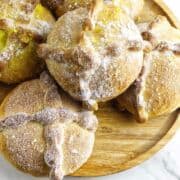
Pan de Muertos (Day of the Dead Bread) is a rich, sweet, anise and orange flavored bread rounds & decorated with bone shaped dough ropes, and sprinkled with granulated sugar. This bread is a beloved tradition in Mexico, often enjoyed during the Day of the Dead celebrations.
Servings: 6 2-3 person loaves
Calories: 304kcal
Equipment
- Large Rimmed Baking Sheets
Ingredients
- ⅔ cup milk
- 2 ¼ teaspoons active dry yeast
- ½ cup sugar
- 5 cups bread flour plus a little extra for work surface
- 1 teaspoon salt
- 1 teaspoon anise seed whole
- 1 cup salted butter melted
- 4 large eggs beaten lightly
- 2 teaspoons orange zest or lemon
For the topping
- ¼ cup salted butter melted
- 1 teaspoon orange zest about 1 orange
- ½ cup granulated sugar
Instructions
- Heat the milk in the microwave in 15-second increments or on the stove until it's just warm to the touch. A thermometer should read around 110°F-115°F.⅔ cup milk
- Stir in the yeast and sugar to combine, then loosely cover with plastic wrap and let it stand for 5 minutes until it gets very foamy.2 ¼ teaspoons active dry yeast, ½ cup sugar
- In the bowl of a stand mixer, whisk together the bread flour, salt, and anise seed.5 cups bread flour, 1 teaspoon salt, 1 teaspoon anise seed
- Attach the dough hook to the mixer and add the melted butter, eggs, orange zest, and yeast mixture. Mix on medium-low speed for 6-8 minutes, until the dough becomes smooth and elastic and pulls away from the bowl.1 cup salted butter, 4 large eggs, 2 teaspoons orange zest
- Coat a large bowl with oil and transfer the dough to the bowl, shaping it into a ball. Cover it with a kitchen towel and let it rise for 2 hours until doubled in size.
- Make the bone-shaped decorations for each loaf. Tear a small piece of dough off of each of the 6 dough dough balls. Roll each into a small ball and set aside.
- Pinch another piece of dough off each loaf and divide in half. Roll each into ropes about 7 inches long. Pinch the dough in intervals to make the 'bone' indentations.
- Drape the two pinched ropes over each of the loaves in a cross shape. Add the small ball at the top. Dampening them first with water will help them adhere and stay in placing during baking.
- Lightly cover with a kitchen towel and let it rise for another 1 ½ hours, or until doubled in size.
- Preheat your oven to 350°F 15 minutes before the end of the second proofing. Bake for 35-40 minutes, or until the tops are golden brown and the bread is fully cooked through. Allow to cool for 30 minutes.
- Prepare the orange flavored topping by whisking together the melted butter and orange zest in a small bowl. Brush the melted butter and orange zest mixture all over the top of the loaves, then sprinkle granulated sugar over the tops of the loaves.¼ cup salted butter, 1 teaspoon orange zest, ½ cup granulated sugar
Notes
- Warm Your Liquids: Ensure your milk and any other liquids are lukewarm (around 105-115°F or 40-46°C) when activating the yeast. This optimal temperature helps the yeast bloom effectively, leading to a properly risen dough.
- Don't Over-Flour: When kneading, add just enough flour to prevent the dough from sticking. Adding too much can result in a dry, dense bread instead of the desired soft and fluffy texture.
- Achieve a Smooth Dough: Knead the dough until it's smooth and elastic. This development of gluten is crucial for the bread's structure and its characteristic tender crumb.
- Proper Proofing is Key: Let the dough rise in a warm, draft-free place until it has genuinely doubled in size. Insufficient proofing will result in a heavy, compact bread.
- Secure the "Bones": When attaching the decorative "bones" to the top of the bread, dampen them lightly before pressing them gently onto the dough rounds. This helps ensure they stick and maintain their shape during baking.
Nutrition
Calories: 304kcal | Carbohydrates: 37g | Protein: 6g | Fat: 15g | Saturated Fat: 9g | Polyunsaturated Fat: 1g | Monounsaturated Fat: 4g | Trans Fat: 1g | Cholesterol: 76mg | Sodium: 231mg | Potassium: 74mg | Fiber: 1g | Sugar: 12g | Vitamin A: 470IU | Vitamin C: 0.5mg | Calcium: 28mg | Iron: 1mg
